
Claude Code stops asking about most commands on Friday 🔓, ChatGPT Ads switches on your form data on the 17th 📤, and the Sonnet 5 price hike is cancelled 💸
Three vendor defaults flip inside six days and every one of them is opt-out. Clay moved plays onto a canvas with no row cap. And a prompt to write your deny rules before Friday.


Hello AI Builders!
Try to remember the last permission prompt you clicked Approve on. Anthropic went and checked whether anyone can, and that is precisely why the prompts are going away.
Three vendor defaults flip inside the next six days, and not one of them waits for you to opt in. Claude Code stops asking about most commands on Friday, ChatGPT Ads starts sending hashed form data from your website on the 17th, and OpenAI deletes a stack of connector syncs on Friday too. The one default that moved in your favor: Anthropic cancelled the Sonnet 5 price increase you were told to budget for.
Read time: 9 min
In this issue:
Claude Code stops asking about most commands on August 14, because humans caught the planted dangerous command 13.6% of the time.
ChatGPT Ads switches on hashed form data by default on August 17, and the opt-out is per pixel and manual.
Clay moved plays off the table and onto a canvas, taking the 50,000 record ceiling with it.
The September 1 Sonnet 5 price hike is cancelled, though the tokenizer math makes it a smaller win than it looks.
+ 6 signals, an independent study that disagrees with Anthropic about you, and a prompt that writes your deny rules before Friday.
New Capability
Claude Code stops asking about most commands on Friday
Source: Anthropic, August 7 2026. Auto mode becomes the default for new sessions on Pro, Max and Team.
On Friday, Claude Code switches its default permission mode for new sessions. Instead of asking you to approve each risky command, a classifier screens every tool call first and blocks, allows, or escalates it.
It does not stop asking entirely, and the difference matters: when the classifier blocks something, Claude either finds a safer route or asks you directly, and after three blocks in a row or twenty across a session it drops back to full manual approvals.
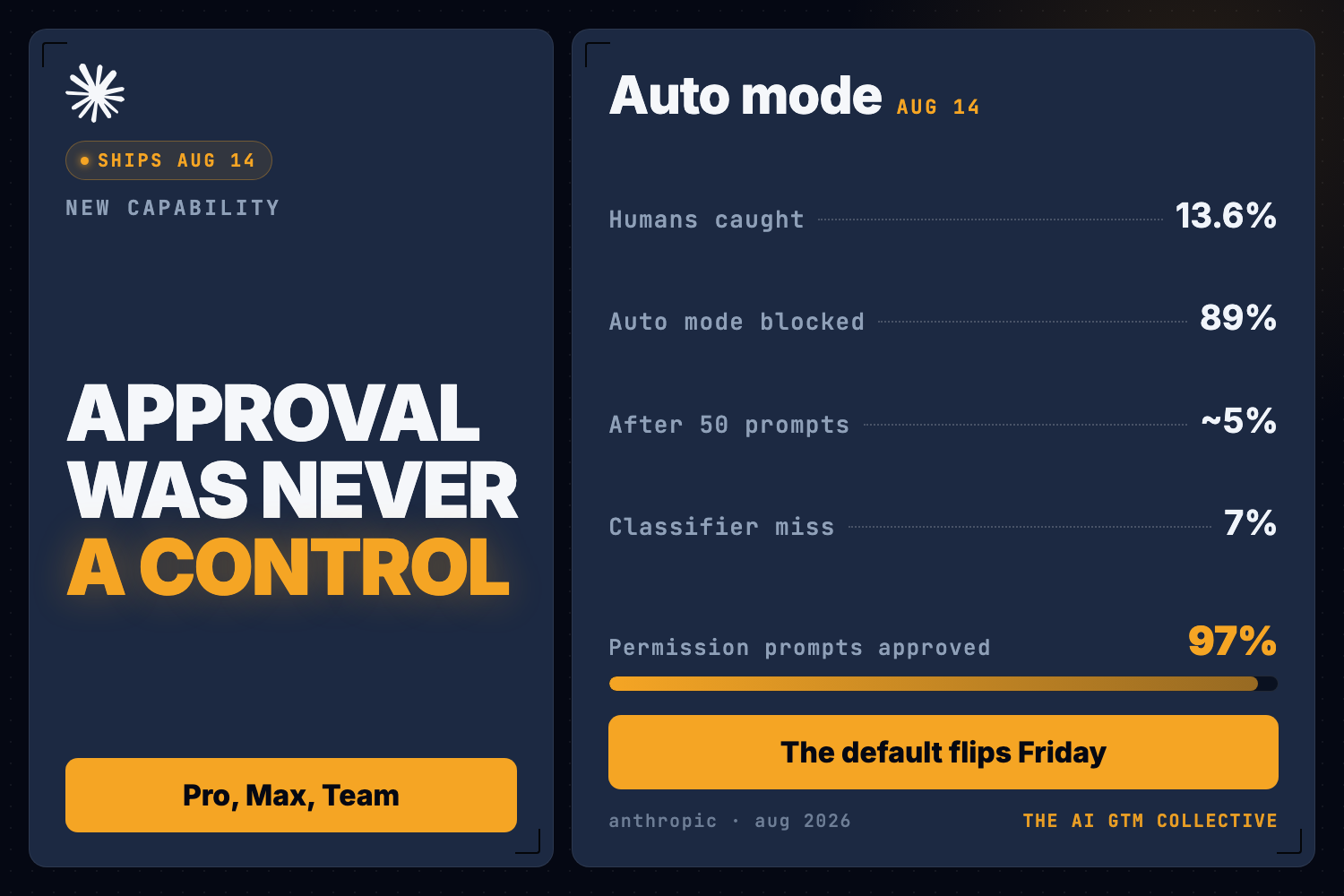
The number behind the decision: in an Anthropic-commissioned study of 1,053 paid testers, humans caught a planted dangerous command 13.6% of the time. Auto mode blocked it 89%.
Approval fatigue is measurable: testers caught about 17% of dangerous commands early in a session, falling to roughly 5% after 50 or more prompts. You get worse at this the longer you work, which is the opposite of how a control should behave.
Most of you had already quit: 49.5% of active CLI users had hand-built a Bash allow-rule by June 2026, and 62% have reached for
bypassPermissionsor “don’t ask again”. The default is catching up to what people were doing anyway.Read the numbers with one eye open: every figure above is vendor-produced and unreplicated, and the classifier still misses 7% of synthetic attacks after hardening, improved from 12%.
There is an independent check, and it is awkward. Two days before Anthropic’s post, ScaleX published results from a browser game where players approve or deny commands for an AI agent: across 40,000 runs and 409,000 approve or deny decisions, the average player missed 1 in 3 threats. That is 66.3% accuracy, not 13.6%, so the two disagree sharply on magnitude while pointing the same direction. It is a self-selected game under artificial time pressure, and its author says so plainly rather than calling it a study. It also found the reverse failure: players blocked the harmless rm -rf dist/ 45% of the time. Human reviewers are noisy in both directions.
GTM Angle: Manual approval was the answer every RevOps and IT team gave their security reviewer, and the vendor just published the number that retires that answer. Agent governance moves from a person clicking to configuration you own, and you have three days of runway. A team that does not set managed settings before Friday has handed its permission policy to a classifier with a documented 7% miss rate, which may well be the right trade, but it should be a decision rather than a thing that happened to you.
Steal this:
Read every CLAUDE.md and settings file in this repo. List each instruction
that tells the agent NOT to do something. For each one, tell me whether it is
enforced by a permission rule or is only text the model can ignore, and write
the deny rule that would make it real.Policy Signal
ChatGPT Ads starts sending your form data on the 17th unless you stop it
Source: Search Engine Land, August 7 2026. Ads Manager release, reported independently by ppc.land the same day.
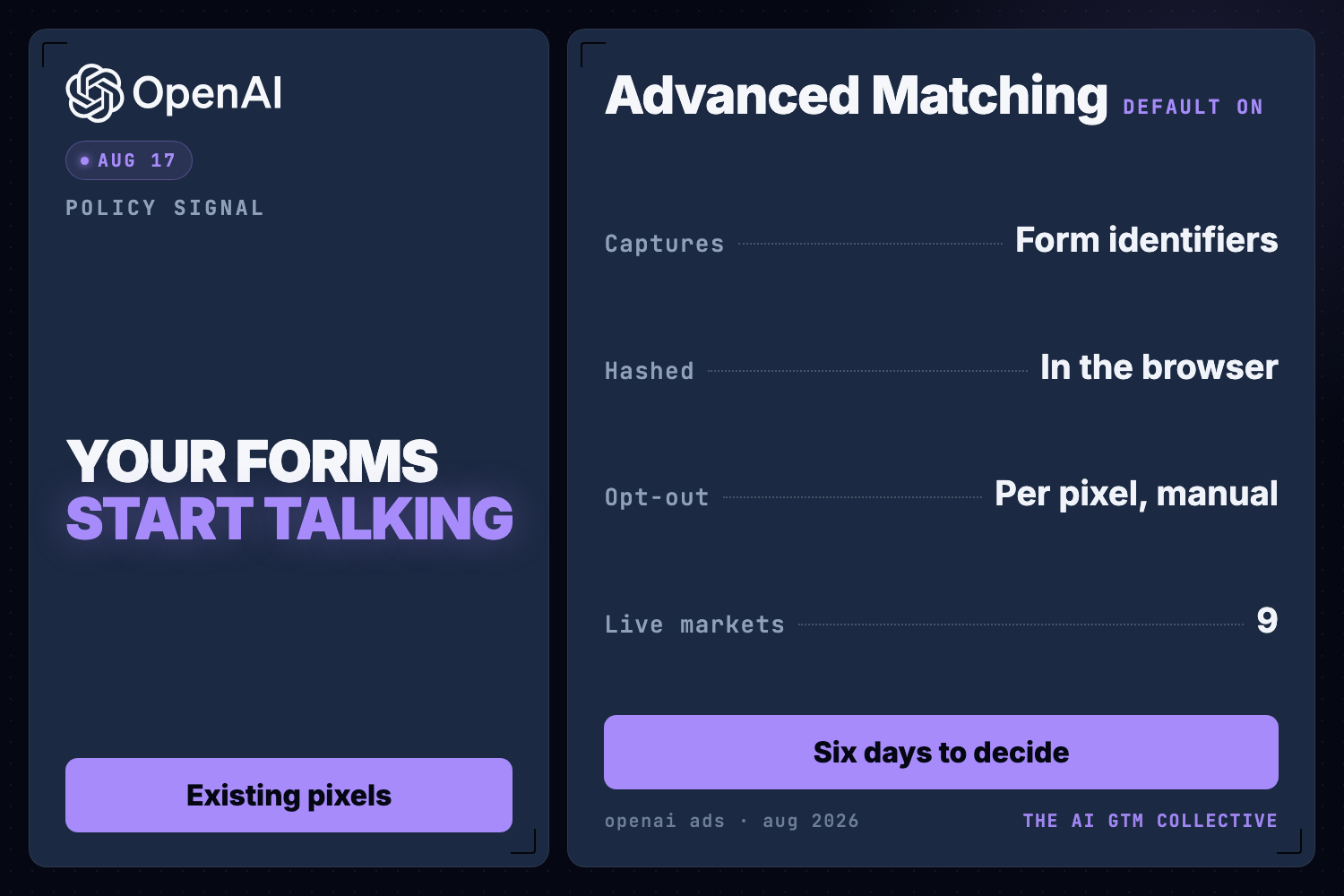
OpenAI made Automatic Advanced Matching the default on all new ChatGPT Ads web pixels immediately, and on August 17 it switches on for every existing pixel unless you opt out first.
What it actually sends: identifiers people type into your website forms, hashed in the browser and transmitted alongside the conversion event, so OpenAI can attribute conversions that cookies and click IDs miss.
The opt-out is manual and per pixel: Tools, then Conversions, then Data Source, then Edit pixel. There is no account-level switch, so a business running eleven pixels does this eleven times.
Six days from today: the release landed August 7 and the auto-enable is August 17, which is a short window for a question that usually involves counsel.
The rest of the release is genuinely useful: conversion-optimized CPC bidding (in beta), dynamic URL parameters so ChatGPT traffic stops landing in analytics as undifferentiated referral, pixel diagnostics that tell you why events were dropped, and measurement connections with Hightouch and Triple Whale.
Worth correcting a claim doing the rounds: the geographic expansion here is smaller than it sounds. ChatGPT Ads is live in nine markets, with Brazil and Mexico imminent, and continental Europe remains absent.
GTM Angle: This is a default-on change to what personal data leaves your website, with a six-day window and no separate consent prompt. Marketing inherits a GDPR and CCPA question nobody asked for, and if you run UK traffic the UK GDPR exposure is immediate. Decide deliberately: keeping it on is defensible and will genuinely improve attribution, but it needs to be written down in your processing records rather than discovered by a privacy review in November.
Steal this:
Here is our cookie banner text and privacy policy (pasted below). We are about
to let an ad platform capture hashed email and phone from our web forms and send
them with conversion events. Tell me plainly whether our current consent language
covers that, and quote the exact sentence that does or the gap that does not.Tool Update
Clay moved plays off the table and onto a canvas
Source: Clay, August 11 2026. Workflows, open beta, shipped today.
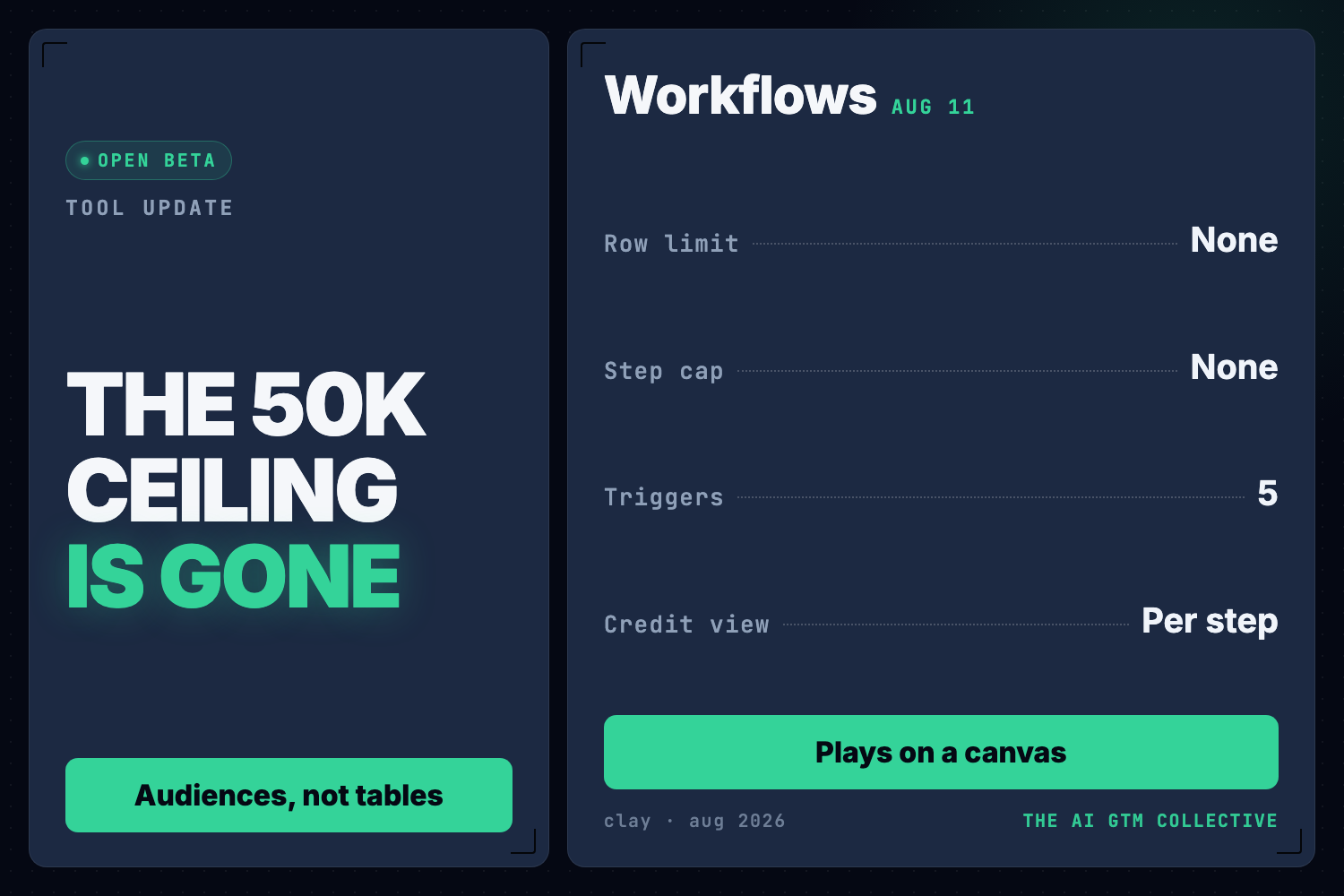
Clay put Workflows into open beta today: a node-based canvas that runs plays on top of Audiences instead of inside a table, which is a different shape for anyone who has chained four tables together with HTTP columns as glue.
The ceiling is gone: no cap on steps and no row limit on how many records a play can act on, which retires the 50,000-record constraint, with working memory per run an order of magnitude larger than a table cell.
Five triggers, three ways to branch: audience membership, a schedule over a segment, webhook, cron, or manual run, branching on field rules, a Python expression, or Claygent’s judgment.
The part that actually changes your week: record-level execution tracing and per-step credit consumption. You can finally answer what a play cost per account without reverse-engineering a credit statement.
Try it on your ugliest play: put deterministic field rules on the cheap branches and a Claygent only on the branch that needs judgment, then read the per-step trace to find the node eating your budget.
One real gap before you migrate everything: you cannot yet source new records through search or waterfall enrichment inside Workflows, so prospecting still starts in a table. Clay says that lands before general availability.
GTM Angle: It costs nothing extra on Enterprise, Growth and Launch and stays that way, so the spending question is credits rather than license, and Clay now shows you where they go per step. Legacy Pro, Explorer and Starter plans get access only through the end of 2026, which makes this a dated migration decision rather than an open one. Tables are not being taken away, so nothing forces your hand this week except that ceiling.
Steal this:
Here is a Clay play currently spread across 4 tables (I will paste the column
list for each). Redraw it as ONE workflow: name each node, say which branch is
a cheap field rule and which genuinely needs an AI judgment call, and flag every
step where I am paying for enrichment on records I later filter out.Tool Update
The Sonnet 5 price increase is cancelled
Source: Anthropic pricing docs, August 10 2026. Confirmed on both the pricing page and the platform release notes.
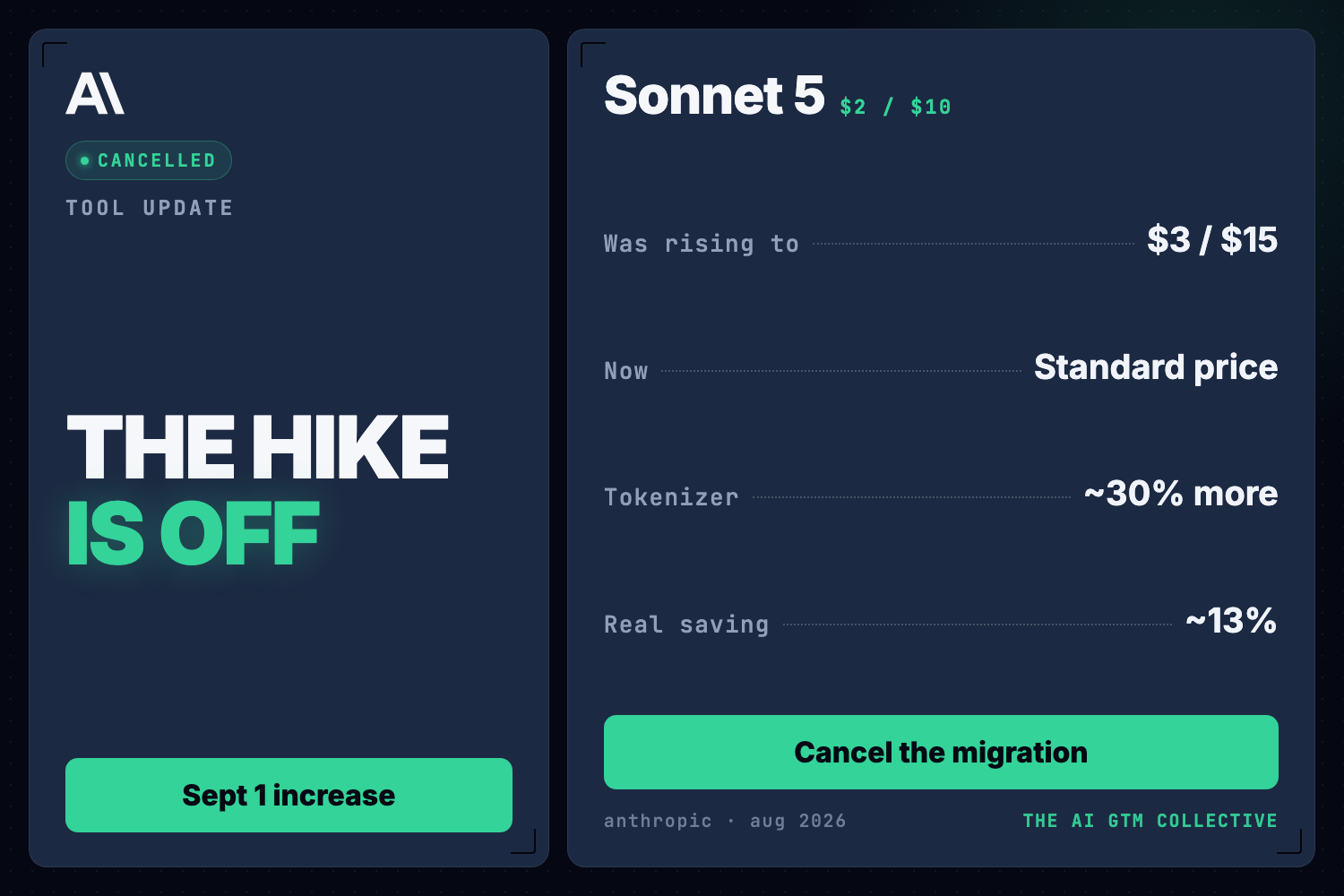
We told you in issue 17 to plan for a 50% increase on September 1. It is not happening, and saying so is more useful than pretending we never raised it. Anthropic’s docs now read that $2 and $10 per million tokens is the standard price, and that the scheduled rise to $3 and $15 will not occur.
Cancel the migration project: if you queued work to move enrichment, classification, summarization or routing off Sonnet 5 before September, stop. That project was always the larger cost.
The catch nobody is quoting: Sonnet 5’s tokenizer produces roughly 30% more tokens for the same text than Sonnet 4.6 and earlier, so $2 against the old $3 compares two different things. Adjusted, you land near $2.60 and $13, closer to a 13% saving than a 33% one.
Two more asterisks: $2 and $10 is the global-routing price, and pinning inference to the US adds a 1.1x multiplier. Sonnet 5 also does not support Priority Tier, which matters if you treat it as the enterprise workhorse.
Batch work stays cheap: the Batch API runs Sonnet 5 at half rate, which is the right home for overnight scoring and classification jobs that nobody is waiting on.
One honest caveat on the good news: Anthropic said the increase will not occur and that this is now the standard price. It did not promise the price is fixed forever, so treat this as a cancelled increase rather than a guarantee.
GTM Angle: At 500 million input and 100 million output tokens a month, a team budgeted for $3,000 from September now stays at $2,000, about $12,000 a year on that volume with no engineering work, and that arithmetic is mine rather than Anthropic’s. The strategic read matters more than the line item: workhorse inference pricing is deflating, so any 2027 plan built on rising per-token cost is now wrong in the wrong direction.
Steal this:
Pull our last 30 days of model spend by workload. For each workload, tell me
whether it needs judgment or is mechanical, then recommend the cheapest model
that would not degrade it. Flag anything running on a premium model that is
really just classification, and show the monthly delta.Signals worth 30 seconds
OpenAI deletes individual-user connector syncs on Friday. Announced August 10, enforced August 14, so four days’ notice. Twelve connectors are affected and nine have no working replacement on the deadline, including Pipedrive and Zoho CRM. Admin-managed sync is untouched, and Drive and SharePoint have a path, though it runs through domain-wide delegation rather than a toggle.
xAI shipped Grok Bot, described in its release notes as durable AI teammates on a persistent cloud computer with messaging, approvals, connectors and routines. The category point beats the vendor point: this is the third persistent computer-using agent to ship, which moves the automation ceiling from “does this tool have an API” to “can a person do this in a browser.”
Desktop agents passed the human baseline. An a16z analysis puts the leader at 85% on OSWorld-Verified against a 72% human baseline, up from 42% a year ago. Treat the number gently, since a venture firm aggregating vendor-reported scores falls well short of an independent lab, but the direction is the story.
Cloudflare built a browser only agents will use. Kitesurf runs on Workers, renders and executes pages, and handles screenshots and HTML extraction without a Chromium instance per session. Every scraping and form-driving workflow you run has a new floor price.
Vercel shipped the install step the plugin spec left out. Skill Packs on skills.sh bundle multiple agent skills into one shareable pack installable with a single command, which is the missing distribution half of the portable-skills story.
Meta’s first Apache 2.0 agentic model runs on a gaming GPU. Muse Glimmer is 30B dense, takes text and images, and quantizes to under 20GB for a 24GB card. Genuinely permissive licensing plus local inference is the combination that makes PII-bearing agent work stop leaving the building.
The prompt to steal this week
Friday is the deadline that matters, so this one writes the artifact you need before it. Paste it into Claude Code at the root of any repo where you run agents.
You are auditing this repository's AI agent permissions before a vendor default
changes on August 14.

STEP 1. Read every CLAUDE.md, AGENTS.md, .claude/settings.json, and any managed
settings file you find. Do not change anything yet.

STEP 2. Build a table of every instruction that restricts the agent. For each row:
  - the instruction, quoted
  - whether it is ENFORCED (a permission or deny rule the runtime applies) or
    ADVISORY (prose the model may ignore)
  - the blast radius if it were ignored once, in one concrete sentence

STEP 3. Ask me which of the advisory ones I actually care about. Wait for my
answer before continuing.

STEP 4. For each one I name, write the specific deny or allow rule that makes it
enforced, and show me the exact file and the exact lines to add. Cover at minimum:
network egress, destructive filesystem commands, and any credential or .env access.

STEP 5. Write permissions-audit.md with the table, the proposed rules, and a short
"what is still only advisory" section at the end.

RULES:
- Do NOT edit any settings file yourself. Propose the diff and let me apply it.
- If you cannot tell whether something is enforced, say so rather than guessing.
- Rank the final list by blast radius, not by how easy the fix is.
About twenty minutes, one repo in, and a written answer to the question your security reviewer is going to ask in October. Runs as-is in Claude Code or Codex.
This is the operator’s guide to keeping up with AI, most days: the Claude, ChatGPT, Cursor and Lovable use cases most GTM teams do not know exist yet, with a prompt to steal every time. Hit subscribe and the next one lands in your inbox.
-Chris
Work With Me
Chris / CEO @ DemandLab Agency
✅ Not sure where your team stands today? Take the AI Maturity Assessment
🏅 Want to get your team up to speed? Explore the DemandLab AI GTM Workshop
📘 Want to learn more about DemandLab? Visit demandlabagency.com
🔗 Want to connect? Find me on LinkedIn